Sunday, 26 January 2014

A Mathematical Epiphany


I have just had a mathematical epiphany.

As some of you may know, for the past five years I have been studying for a degree in mathematics and statistics with the Open University. However, the first four years of this have mainly focused on the practical application (generally using statistical software) of statistical tools, techniques and proofs, without getting too hung up on the mathematics behind them. The proofs are given without detail; it’s what you do with them that counts.

This year’s course, however, is different. The title of the course is “Mathematical Statistics” and, as the name suggests, is much more about the mathematical theory behind the statistical techniques employed daily by statisticians. In other words, this year’s course is bloody tough.

And I have to confess, I’ve struggled with it somewhat so far. Calculus, my long-term bug-bear, is biting me with a vengeance this year, and it’s been hard-going sometimes to bring myself back up to speed with it.

All of that said, today I had an experience which gave me a glimpse—a snapshot taken through a keyhole, perhaps, but a glimpse nonetheless—of what it feels like to be a professional, or even a proficient amateur, mathematician.

Today I proved a result. A result, I must point out, that has been known for the best part of 70 years, and a result for which regulation undergraduate mathematics is quite sufficient. It was also a result whose answer I was given. Had I not been given this final answer, it is entirely likely that I may not have discovered it for myself at all.

Nevertheless, I did prove it myself, without reference to other texts, cribbing from the course materials, or consulting with that information whore Google. The experience sits in my memory now as though a journey through a new and unfamiliar landscape, seeking out a path towards a final destination whose location is known but to which the route is not.

I was air-lifted into this terra incognita without map or compass; merely a photograph of my destination, in order that I would recognize it when I arrived. I also commenced the journey with a familiarity not of the area itself but of the various features I was likely to encounter.

As I sought a path through this mysterious land, I was, at first, presented with a multitude of possible directions in which to strike out. However, on closer inspection, it was possible to rule out certain possibilities immediately: this path, I could see, led towards a broad, raging river, down in the valley. Unlikely, I felt, that the correct path would require me to ford such an obstacle.  This path, on the other hand, appeared to peter out at the foot of a steep, craggy cliff. Not a good option either.

By these means one can reduce the number of potential routes to explore, but perhaps not down to a single option, and in the end one must simply choose a way, perhaps at random, to explore. Eventually, one will discover whether one has chosen wisely or not. It is perhaps as likely as not, at this early stage, that one will be forced to retrace one’s steps, perhaps right back to the very start point, before setting out in a different direction.

After a while, however, one particular path seemed to become more promising. There were still occasional backtrackings—the path might, for example, run towards an area of boggy ground which could not be crossed and which therefore required circumnavigation. However, this required not a return to the start but merely a return to a suitable branching point.

By little and little, guided by experience, instinct and with a certain degree of trial and error, I picked my way through. And then it happened; as I emerged from a thicket of woodland, I realized that there was, in fact, just a single path laid out in front of me, and from my present standpoint, I could see my destination ahead. From here I was able to divine the entirety of my remaining journey: down this hillside, avoid the outcropping to the north, cross the stream by the stepping-stones, through the stone wall at the style, and on home.

Those final few steps were taken with a sense of excitement and awe the like of which I have never before experienced. Reaching my goal, I looked back at the journey taken and realized what an event of sublime beauty had just occurred.

I was not the first—not even the million-and-first—person to have walked that route; I had not required climbing equipment, specialist clothing or navigational aids with which to traverse the land. Yet I had been able, by repeated applications of induction and deduction, to find my way to a given omega from an unknown alpha. This, I realized, was the daily pleasure and privilege of the mathematician: to live and work (and play) in this landscape, explore its ways, its paths, its routes and roads, to discover new routes yet untrod by human foot; to bring familiarity to the unknown, and to map the terrain for future travellers.

It is a land in which I could happily pitch my tent and explore forever.

Thursday, 19 September 2013

Portsoy and the Loss of a Craft

In the least-known part of Scotland, the acute-angled bit jutting out north of Aberdeen, is the area called Banffshire. Officially, now, this is all part of Aberdeenshire, but it is still known colloquially as Banffshire, the area surrounding the solid, sturdy little town of Banff. Drive westwards along the main road out of Banff and you will, after a few miles, arrive at Portsoy.


Portsoy is typical of the many fishing villages strung out at regular intervals along the entire Moray and north Aberdeenshire coastline, and is just as typically untouched and unspoiled. It boasts a charming seventeenth century harbour which—outwith the rather more modern boats, and the car tyres providing buffers to prevent boats running into the harbour walls—must have looked almost identical three hundred years ago to how it looks today. Flanking the harbour is a number of buildings of similar age, which would have been used for storage, chandlery, workshops and the like. In one of these can now be found a shop called Portsoy Marble.


One of Portsoy’s chief “claims to fame” is that it is the only place where the stone which is now known as Portsoy marble can be found. Portsoy marble (actually not marble but a form of Serpentine) comes in a range of hues, from turquoise, through sea green/grey, to a deep chocolate brown and oxide red. 


Every piece is different, and the seam itself was long ago exhausted, a good proportion of it having been used in the Palace of Versailles. Today what remains is only those pieces that are found along the beach. In Portsoy Marble, alongside many gems and fossils, one can still buy pieces made from the rare and attractive stone which gives the shop its name…but not for much longer, it seems.

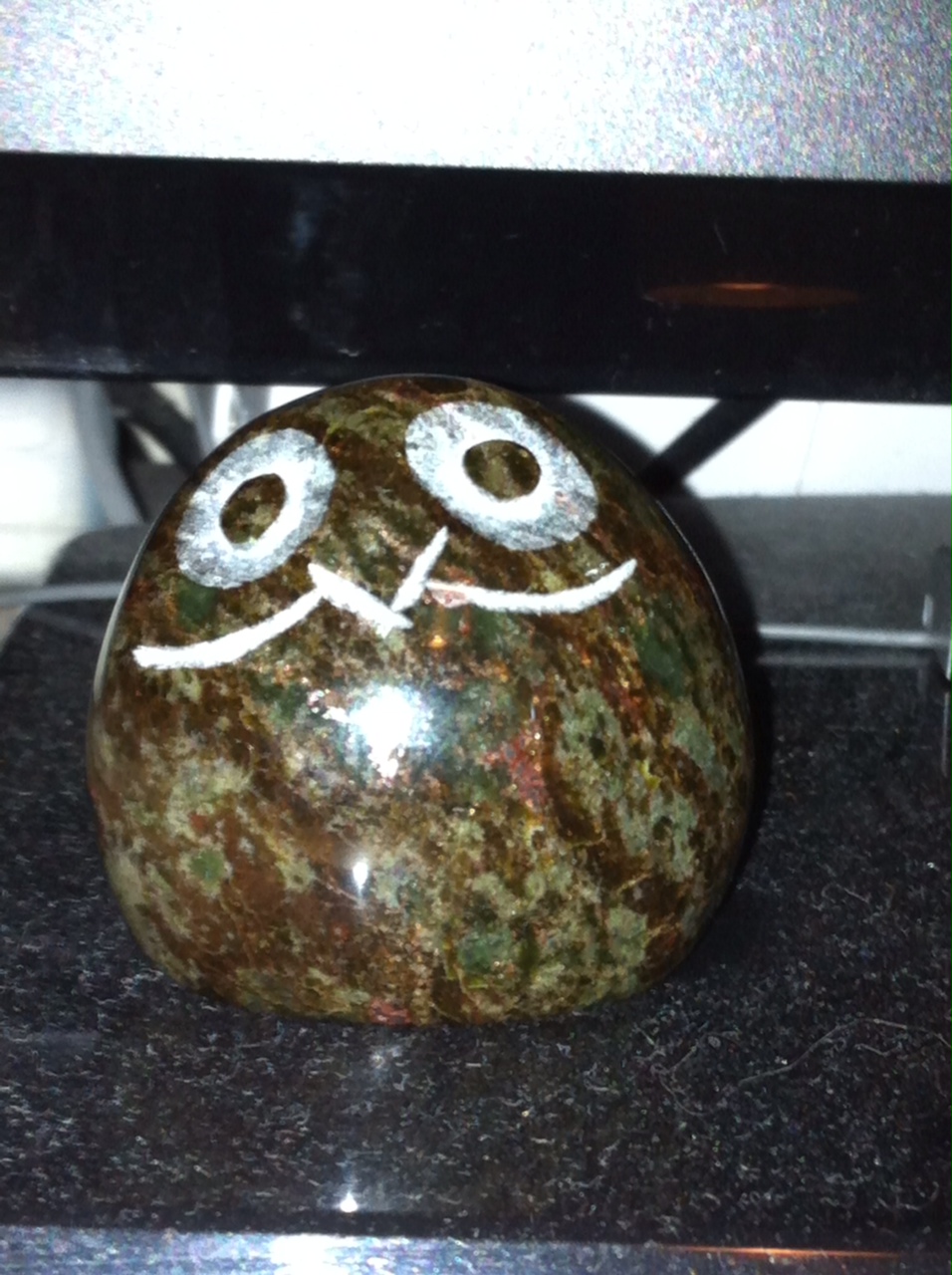
I have been visiting Portsoy for the past five years on my annual pilgrimage to this most beautiful of areas, and on my visit last year heard the sad news that the old gentleman responsible for working the stone into paperweights, eggs, key fobs, “Fyvie balls” and charming little owls, had just died. On this year's visit, the pieces of Portsoy marble available had dwindled to a handful of smooth,  randomly shaped paperweights, a couple of key fobs, and one solitary egg (which I bought). I talked to the owner about the situation and at the present time he isn’t sure whether or not there will be any more pieces once the present ones have gone.


For many years the old gentleman worked in his workshop next to the shop, producing the balls, eggs, owls and other pieces. In that one single man was invested a lifetime of experience and skill, which allowed him to produce such items with great dexterity and sureness of touch. The problem now confronting the owner is twofold: firstly, he has no one to teach him the skills, and secondly he cannot afford the huge commitment of time and effort required to attain them. In these days where everything must be costed and accounted for, it is simply impossible for him to produce saleable pieces without wasting more stone than he uses and without it taking far too long to be worth his while.

And so, it seems, the three or four owls I bought last year, and the egg I managed to obtain this year, may be amongst the last pieces of Portsoy marble sold. Unless the owner has a change of heart, or unless he can find someone who already has stoneworking skills necessary to produce new pieces economically, that will be the case.

There is much to be said for economies of scale, rationalizing of costs, efficiency savings and the rest. There is no doubt that these are the engines of affordability and were it not for our major businesses and corporations continuing to pursue these rainbow-terminating pots of gold, much of the consumer goods we enjoy today would be beyond our budget. But there is something unbearably sad about watching such manual skills passing out of existence, about bearing witness to a craft passing from the present into the past with, apparently, nothing to prevent it happening.

No blame for this attaches to the owner of the shop, of course; he must make a living the same as the rest of us, and if it took him all week to make one little owl, no one could afford to pay for it a price sufficient to cover his costs and give him a reasonable profit for his efforts. But we must guard and cherish such skills as still remain and do more to ensure they continue.

Picking up one of the few pieces of Portsoy marble I am fortunate enough to own, I can feel the way they must have been held in the rough, calloused, skillful fingers of their maker, as he turned them around and around in his hand, working, sanding, smoothing, checking for imperfections with an experienced eye and refined touch until he was satisfied with the piece. I was never lucky enough to meet him, but I imagine him to have given a gruff grunt of approval at each one he finished. These are qualities intangible within the stone; you could cut the stone into smaller and smaller pebbles without finding them, yet they are no less real for it. Embedded within each piece is the time, care and love invested in them by their creator. And something similar can be found in every pot, toy, piece of furniture or jewellery made in a similar way. These are qualities far, far beyond mere pounds and pence.


Thursday, 22 September 2011

Peripheral Vision -- One of my earliest pieces of writing (be gentle!)

1998

It was one of his favourite places. Since he discovered it about five years ago, he’d lost count of the number of visits he’d made here. Approaching the village along the gently winding road, he anticipated spending an enjoyable hour or so browsing in the tiny yet packed bookshop, a converted three-story terrace in a row built, originally, to house mill-workers in this most important of Derbyshire villages.

Cromford stood out in English history for one very good reason: it was arguably the birthplace of the Industrial Revolution. In 1771 Sir Richard Arkwright chose this site to build his first water-powered cotton mill, because of the existence of the strong, fast-running Bonsall Brook, which flowed into the River Derwent at Cromford. The waters of Bonsall Brook were warm, owing to the hot springs further up in the hills which formed its tributaries, meaning the water did not freeze in winter and thus making it an ideal source of power for his water wheels. The village grew up around the mill; houses, shops and other necessities of life sprang up to support the battalion of mill-workers.

He turned left at the traffic lights in the middle of the village, then turned right into the car-park fronting the magnificent stone-built Greyhound Inn, an imperious and imposing monument to eighteenth-century confidence.

Climbing out of the car into the warm June morning, Pete stretched, closed and locked the car door, and started the short walk to the bookshop. The village was beautiful not, perhaps, in a quaint “chocolate-box” way, but because of the character and history of its buildings. It was a miniature of a northern mill town, where King Cotton had served for a while as a Prince. Most of the buildings were tall and narrow, long terraces winding up steep hills away from the brook running through the centre of the village, past the famous mill. He walked through a short alley and into Scarthin, a particularly picturesque terrace, narrow and cobbled, the Black Swan Inn on one side, the tiny Post Office on the other. Further up, on the same side as the Post Office, was his destination. Scarthin Books, the most fantastic bookshop he’d ever been in. He approached the tiny shop, squeezed through the narrow doors, immersed himself in the unique smell of aged tomes, and lost himself among the labyrinthine aisles, corridors and landings, totally content.


1983

There was an air of excitement and anticipation, as always on these occasions, as the minibus was loaded after school finished on Friday night. The two teachers, Mr. Rogers and Mrs (perpetually referred to as “Miss” by the pupils) Newbury, packed the bags into the bus while the children talked loudly, ran, chased, screamed, and generally caused mayhem around the playground.

When all the bags had been packed, Mr. Rogers called his lary wards to order. “Right. Calm down, shut up, and get on the bus in an orderly fashion, please. Just find a seat, it doesn’t matter where you sit, let’s get moving.”

Mrs. Newbury did a head-count as the twenty-one twelve- and thirteen-year-olds climbed onto the mini-bus, racing to find the best seats alongside their particular friends, in total disregard to the given instructions.
After a few minutes of general musical chairs and a last minute conflab between the two teachers, the minibus departed through the school gates, Mr. Rogers at the wheel.

A school field trip was the very epitome of excitement and adventure for these youngsters, half-way between children and young adults. A weekend away from home, maybe a chance to flirt in a half-innocent, half-knowing way with fancied members of the opposite sex—usually amounting to displays of strength from the boys, met with feigned disgust and disregard from the girls. For Pete, sitting alongside his best friend Jason, it was no different, although being rather shy he was not normally given to showing off for the benefit of certain girls, even though his feelings towards them were the same as most thirteen-year-old boys.

The drive to Cromford was not a long one, being only about twenty miles in distance, and took just under an hour, but for children of that age, it was a world away.

The minibus moved along the winding road, flanked by a steep wooded hillside on the left, and an equally steep wooded drop to the right, down to the old Cromford canal running along the bottom of the narrow valley. Presently they came to a narrow, partly concealed driveway through the trees; the sign read, “The Wharfshed. Property of the Derbyshire Education Authority.” Mr. Rogers pulled the bus off the road and drove carefully down the steep track towards the canal, and pulled to a stop in a cleared area surrounded by several small buildings and one rather larger one, the Wharfshed itself, now converted into a small hostel for school trips, right on the very edge of the canal.

After another display by the group of excitement, anticipation and general horseplay whilst unloading the vehicle, the two teachers led their flock into the hostel, showed them the separate girls’ and boys’ dormitories, and left them to their own devices for a while, for the ritual of fighting for upper and lower bunks, ribbing, teasing, and discussions about prospective rendezvous with various members of the opposite dormitory.

After their evening meal, eaten to the accompaniment of rattled cutlery, youthful raised voices and laughter, they were led into the common room and, after finally getting settled in, on and around the chairs and sofas, were given the itinerary for the following day.

“Okay, lads and lasses,” began Mr. Rogers in his usual way, “Tomorrow we’ll walk down the canal into Cromford village; it’s about three miles.” This was greeted by exactly twenty-one groans. “Alright, alright. Then, we’re going to have a good look around Cromford, but the way we’re going to do it is this: You’ll split up into groups of three. Each group will have a map of the village, a list of things to find in the village, and a task for each one. Now, you’ll need to find each item or place on the map first, then find your way to that place so that you’ll be able to complete the question. Some of the questions will need written answers, some will required you to draw. You’ll have about three hours in Cromford, you’ll all have a packed lunch, then we’ll meet up and walk back along the canal again. After tea we’ll see which group got the best score, and there just may be a prize for the winners.”

This was received with somewhat more enthusiasm, although thirteen-year-old adults are not easily impressed, so the obvious excitement quickly subsided into adolescent laissez-faire.

After this speech, the group was allowed to do their own thing for a couple of hours before bedtime. Pete, along with Jason and Mark, went to look at the canal. As they walked along the towpath, they came to a narrow inlet (or outlet, it was impossible to tell which), complete with a sluice gate. Jason and Mark walked along the narrow dam, over the raised top of the sluice gate, and onto the towpath at the other side. Pete, always a little awkward, was the last to go, and gingerly stepped out onto the slippery dam. It was hard enough just to keep his balance, but as soon as he left the safety of the towpath, Mark and Jason started throwing stones in the water to either side of him. Although he knew they were not aimed at him, it put him off sufficiently that he lost his balance, tipped over to the right, briefly managed to steady himself by placing his foot onto a slippery rotted log, before slipping again and landing in the green canal water with both feet, the water reaching almost up to his knees.

To the sound of uncontrollable laughter from his “friends”, he climbed out of the inlet, trainers and jeans absolutely sodden. “You prats!”, he shouted, trying not to laugh himself. “Look at me, I’m bloody soaked.”

After another half-hour’s walking, though, the garments were dry and friendships restored. It would not always be so easy, but at thirteen, these sorts of things were quickly forgotten.

Getting the kids, particularly the boys, to go to sleep that night was no easy task for the two teachers, and it was after midnight when all the laughing, joking and surreptitious attacks on unsuspecting sleepers finally died down.


1998

Pete was in heaven as he mooched around the cramped bookshop. Every available space was filled with books; floor to ceiling shelves, shelving up both sides of the stairs, shelves on the landing, and in all of the former bedrooms. It was an Aladdin’s cave for bookworms, and for more than an hour he was lost in the world of words.

When he finally emerged into the outside world again, bright sunshine making him squint, he happened to glance across the road. For some reason, though he had been here many times, he had never before looked in precisely this direction, and the view was one that was immediately familiar to him. He wandered across the narrow cobbled street, the heavy bagful of books knocking the side of his leg, to the railings across the street. On the other side of the railings was an almost perfectly circular millpond, the surface of which was so flat and mirror-like, it could have been the very millpond people had in mind when they used it as a simile for any flat, calm body of water. Pete looked at the pond, then over to the other side where a row of tall, narrow houses lined up like a bad set of lower teeth, uneven in height and colour.

He knew this place, knew he had been here before, but could not bring the memory into focus.

There was a wooden bench here, placed so people could sit and look out over the pond, and he sat down, lifting the bag of books onto the seat beside him. For a while he just gazed out over the pond, trying to bring that elusive scrap of memory out of its pigeonhole.


1983

The June morning was bright and warm as the young group assembled roughly and energetically outside the Wharfshed. After once more checking that all were present and correct, Mr. Rogers and Mrs. Newbury led the group off down the towpath. Twenty-one youngsters with clipboards in hand, looking like trainee market-researchers, followed on, laughing, fooling, attempting to push each other into the canal. Just a bit of fun.

After an hour, the ragged group reached the village, where they climbed the steep path up from the canal to a grassy area by the traffic-lighted crossroads in the centre of the village.

Mr. Rogers gave the instructions. “Okay, you’ve all got your worksheets, all got your packed lunches, so I want you to split into groups of three.” This was the cue for a round of chaos, some groups forming quickly, some individuals floating round before joining, or being joined to, spare pairs. Eventually, seven groups of three enthusiastic teenagers each could just about be discerned.

“Right”, continued Mr. Rogers, “it’s eleven o’clock now, so we’ll all meet up here again at two o’clock. Now I want no stupidity, no messing about,” (fat chance), “and I want you all to be very careful of these roads. They’re busy and there are a lot of quarry lorries going up and down, so look what you’re doing. There’re plenty of pedestrian crossings; please use them. Okay, off you go, and good luck.”

Twenty-one excited, happy adolescents walked off briskly, not, of course, with the anticipation of looking round a very important site for English Industrial History, but with the enthusiasm of dogs being let off the leash in a field full of rabbits.

Pete was in a group with Mark and Jason, and they crossed the busy main road to stand on the pavement edging the market square, empty of stalls this morning but full of cars. Pete looked at the list of tasks, and read out the first. “The Greyhound Inn was built in 1797, and has a magnificent example of a late Georgian frontage, built in the local materials of limestone and millstone grit. In the space below, make a sketch of the front of the Hotel.” Since it would have been virtually impossible to stand where they stood and not see the Inn, the maps were not immediately required.

This would be tricky, particularly for Pete, who had never shown much aptitude for freehand drawing, but the three stood in a line in front of the solidly-built edifice, and for the next twenty minutes or so attempted, with varying degrees of artistic ability, to replicate the beautifully symmetric frontage of the building, with its saw-tooth patterned limestone block edging and nineteen small-paned windows, finishing off with the clock in the centre of the pediment.

Sometime later, after much comparing with and deriding of each other’s efforts, the three looked at their next appointed task.

“Find the waterwheel next to the millpond, and count the number of blades. Also describe the type of waterwheel (undershot or overshot), and briefly explain how it would have worked.”

After consulting their maps, they found that the millpond was directly behind the Greyhound Inn, just up a narrow street, so they set off with typical youthful speed. Rounding the Black Swan Pub, they found the millpond and, adjoining it, the old mill, complete with waterwheel, which did in fact turn out to be of the undershot variety. As they made their way to the edge of the millpond, Pete noticed, out of the corner of his eye, a youngish man sitting on a bench a little further up. He seemed to be just staring straight ahead, and Pete wondered if he was perhaps a little simple. But there were more important things to attend to. The three friends stood at the edge of the millpond, leaning on the rusty railings, and began to count the blades of the old, disused waterwheel. The soft breeze failed to make any impression on the millpond, which was as flat as a marble floor. Counting the blades was fairly easy, since the water level was now low enough to see the blades all the way around the wheel. After arguing then agreeing on how to describe the relatively simple mechanism involved, they decided to attack their packed lunches, and Jason pointed to the bench and suggested they go and sit on it to eat.

When Pete looked over to the bench, the man he had seen earlier had gone. “Where did that bloke go?” he asked the others. “What bloke?” said Mark, a tinge of sarcasm just beginning to colour his words.

“There was a bloke sitting on that bench when we came, he was just staring out at the pond. I think he was a loony or something.”

“There’s only one loony round here”, said Mark, in full flow now, “and I’m looking at him. There wasn’t anybody on the bench. I looked at it when we first came round.”

Jason agreed that there had been no-one on the bench, and the three went and sat down on the bench. Pete was puzzled for a while, but at thirteen these sorts of things are quickly forgotten.


1998

As Pete gazed into the millpond, his vision gradually de-focussing, he began to recall why this particular view had been familiar. It must have been on that school field trip, God knows how many years ago, when they were sent out around the village in groups. Who had he been with? That’s right, Jason, his best friend at the time, and Mark. They must have come here to see the pond and the waterwheel. As the memories came back to him, he smiled to himself as he thought of happier times, when spending a weekend just a few miles from home was such an adventure and life, in general, was simpler and brighter. And now his vision blurred further and he realized he was looking at the millpond through a film of tears.

It was movement on the surface of the water that brought his attention back to the present, and as he focused on the pond once more he could see that it was not the water itself that was rippling, but that there was a reflection on the glassy surface. There seemed to be three people walking towards him. Was it three kids? As he turned to the left to look, he could see no-one on the street and, turning back to the millpond, the reflections had disappeared. The millpond was still mirror-calm. After a minute or two he stood up, picked up his bag of books, and walked back down Scarthin to his car outside the Greyhound Inn.

Monday, 8 February 2010

God or Not

I tend to avoid talking (or even blogging!) about religion, because if I would prefer people to keep their personal beliefs to themselves and not try and foist them onto me, then I feel I should practice the same restraint. However, I am making this one exception to my general rule, and hope I will be forgiven. Having decided to write something on the subject, though, I am of course prepared and ready for whatever comments anyone who reads this may wish to make!

Last night I watched the third part of Channel 4's excellent "The Bible: A History", this episode being presented by the intensely irritating Anne Widdecombe. However, I forebore my annoyance because I was interested to see what she and others had to say. The topic, for anyone who didn't see it, was the 10 Mosaic Commandments, how they form not only the basis of religious morality, but also of English Common Law, and how they should still underpin our behaviour today.

I could feel my annoyance growing--as it tends to do these days very quickly when I hear people defending the literal truth of the Bible--and found myself wondering why such basic, obvious tenets as "don't kill" should necessarily have a religious origin. Surely these ideas--don't kill, treat other people the way you would like to be treated, don't steal, etc.--are essential axioms for human society? Must they have been handed down by God? And are we to believe that before God's chat with Moses, such things were commonplace and acceptable?

I was brought up a Christian. My parents were both active in our local church, my father being both choirmaster and lay preacher up until his cruelly premature death at the age of 32. Since then my faith has been on a generally downward slope, and today I find it virtually impossible to hold on to a belief in any kind of omnipotent, omniscient, essentially benevolent God, when simply turning on the TV brings so much evidence to the contrary. Today it is from Haiti. Before that it was New Orleans. Before that, Indonesia and Sri Lanka. All of these places lost tens, hundreds of thousands of good, law-abiding and--in the majority of cases--religious people. I know it's an old and hackneyed argument against the existence of God, but it doesn't make it any less potent, and if an argument is good enough for Richard Dawkins, its certainly good enough for me.

What do such disasters tell us about God, and a belief in Him? We are presented with three equally unsatisfactory options, it seems to me, if we wish to maintain a belief in God:

1) God is neither omnipotent nor omniscient, and cannot prevent natural disasters
2) God could prevent such tragedies but chooses not to
3) "God works in mysterious ways."

Which of those would I most like to have as my own creed? Frankly, none! Do I find infinitely more palatable the idea that in fact there is no God, at least in the sense that the major religions cast him, and that such events just happen? Yes, hugely so. There are geological and meteorological reasons why, and that's all. On a human scale such disasters are immense, beyond comprehension, but I actually start to feel a certain comfort in knowing that these events were neither a punishment from God, something that He chose to allow to happen even though He had the power to prevent it, or that He couldn't have stopped it even if He'd wanted. The Universe may not care about us one iota, but I actually find that more acceptable than a punitive or powerless God.

So why do I still have even the slightest lingering doubt, the last remains of a reluctance to call myself an atheist? That one is easy to answer: because in that simple and--apparently--obvious act, I would be killing my father. Since the age of nine I have held on to the belief that I would one day see him again, in Heaven. By finally losing totally my faith in God, I would be forced to accept that my father left my life for good when he died thirty years ago, and his spirit died with him. 

I have two hundred thousand Haitian deaths telling me there can be no God, and a single one telling me I must hang on to the possibility that there is. And as illogical as it may seem, the scales aren't entirely tipped towards Haiti.

Thursday, 4 February 2010

Sleepers Awake

In the news today is the most remarkable story about UK and Belgian researchers who have found a way to communicate with patients in PVS (Persistent Vegetative State). They have been able to elicit Yes/No answers to their questions by asking patients to imagine themselves playing tennis if the answer is yes, and by then recording activity in the parts of the brain responsible for movement.


This, as I'm sure goes without saying, is an extraordinary discovery and, if further research and wider trials continue to back up their findings, opens up a huge potential for treating and possibly even curing many PVS patients. It will bring hope to hundreds of thousands of friends and family members of people in PVS that they may once again be able to reach their loved ones. It also provokes thoughts about current treatment of people in this condition, and surely must affect decisions about termination of life support or withholding of medical treatment should they become ill.

I don't think I really have anything controversial, profound or insightful to say on this, it just struck as by far the most amazing and potentially far-reaching piece of news I've seen for a very long time. Considering the pace of modern developments in our ability to read, map and interpret brain activity, it surely cannot be beyond our realistic imagination that within a relatively small number if years doctors will be able to go much further than simple "yes/no" responses, and actually read the complex thoughts of people in PVS. And what a revelation those thoughts will be. 

Wednesday, 20 January 2010

Windmill Dreams

Do the wind turbines atop our hills and mountains sing of hope for the future, or intone our past failures? When they watch us, ant-like from their Olympean heights, do they look down on us in pity, anger or compassion?


Wind turbines polarize views. Champions point out the free, clean, infinite energy source waiting to be tapped, which will free our air of fossil-fuel fumes, and allow our atmosphere to repair itself. They talk of the critical need to reduce carbon emissions, to mitigate as far as possible the potentially devastating effects of climate change, to which we as an island may be particularly vulnerable. They point out that the landscape we cherish is under threat, and if the alternative to its total loss or transformation is the erection of these white leviathans, then that is a price worth paying.


Opponents decry the loss of unspoiled vistas, landscapes virtually unchanged since Turner, Constable and Gainsborough captured them on canvas; the impact on bird populations who have little chance against the giant blades travelling at over 100mph; they claim that they are inefficient, expensive white elephants which cannot solve the problem of replacing fossil fuels.


And as the arguments rage around them, the turbines keep turning, and as they turn, they watch. They are both markers of our failure to grasp earlier the changes happening in our climate, and to act more quickly and decisively, and at the same time sentinels of a future hope that the worst impacts of those changes may be avoided. They may not provide the entire solution but over and above their individual contribution to our energy needs, they represent the results of what we can achieve when we steer our scientific and technological abilities in the right direction.


So when I look at that distant hill, crowned with grey-white turning statues, I do see hope. Tinged with regret that such major changes are becoming increasingly urgent and that it is already too late to entirely prevent the effects of climate change, but hope nevertheless, that we do have the ability to generate the energy we require to sate our greed from clean, renewable resources. 


And I also happen to think that if Messrs Constable, Turner and Gainsborough were around today, they would be reaching for their Titanium White with a certain relish.

Monday, 11 January 2010

Down The Lane

Over Christmas, I spent a few days at my mother's house, the house I grew up in, the house in which I spent the entirety of my generally happy childhood.


After the usual over-eating of Christmas lunch, I decided to take a walk. My mother lives on the edge of a smallish, rather anonymous village, and running down the side of her small house and garden is a narrow lane which winds between a mile or two of fields to the next village. This was the route I decided to take so, wrapped up against the unusually icy weather of this winter, I set off.


The road has a name, but to us it has always been known simply as "the lane." As I walked down between the high hedgerows, the road itself sunken into the landscape by several hundred years of footsteps, horses hooves, cart-wheels and car tyres, my mind drifted away from the present moment, to countless occasions during my childhood when I had walked this same path.


To us, "going down the lane" was always an adventure. There was an air of the mysterious about it. As it meanders its way left and right, climbing hills then running down to the base on the other side to cross over streams, all the time half-hidden between the banks and hedges flanking it, it keeps itself half-hidden, so to young, forming minds, it seemed to hold something new and different with every new stretch which became visible as we walked.


I remembered, too, how much further it seemed. To an adult, a walk to the next village would take no more than forty minutes. To a six-year-old, however, it was a trek that had no ending, a journey into the wilds of the unknown country. There were strange and exotic things to be found as one followed it, and once sight of our house had been lost behind the hedge and the hill we had just crested, we were truly in a foreign land.


After barely ten minutes, I came to "the brook." I remembered how, in early childhood, common features such as brooks, hills, fields and lanes were thought of not simply as one specific instance out of a thousand, but as a singular, unique item, to be denoted by use of the definite article. Our world consisted almost entirely of what could be seen from our window and, since within that proscribed view there was only one such run of water visible, this became "the brook," in exactly the same way that the one road was "the lane," and the one un-metalled track that ran off it was "the dirt-track." The field at the bottom of the garden was "the field," and the playing field at the end of the road was "the rec." No need to be more specific; our world consisted of just one of each feature. Such simple times.


The lane crosses over the brook without fuss; no quaint hump-backed bridge, no dramatic ford, just a utilitarian flat bridge running over a concrete tunnel beneath. I stopped here for a moment, recalling the sense of slightly guilty excitement of the times when, as a seven- or eight-year old boy, I would play under the bridge with my friend. We would have followed the brook from close to his house some half a mile away--a lengthy journey in our world--to arrive at this point. The sense of danger was palpable as we entered the dark tunnel, and if a car were to pass over the bridge as we were underneath it, this excitement would be heightened to almost unbearable levels. Surely the whole thing would choose precisely the moment when two small boys had chosen to clamber through it to crash down, entombing us beneath concrete, masonry and twisted metal?


Beyond the bridge, the road climbs again, towards the destination for many of our childhood walks: "Wooden Hut." Not within my memory has there been an actual wooden hut anywhere in the vicinity, but one supposes that once there was, and this gave rise to its name.


It is very hard to describe this place in a way that would convey the sense of mystery, excitement and joy with which we reached it. In essence, it consists of a stand of trees, bisected by the road. The actions of rain over decades have eroded out the roots of the trees on each side of the road, so that they now form a knotted wooden jumble on the red-earth banks. Climbing up these, one can reach the top of the bank and stand amongst the trees. As I reached this place so indelibly burned into my early memories, so powerful were my recollections I could almost hear those delighted yelps as we ran down one bank, across the road and up the other side, using the exposed roots as make-shift ladders.


On one side of the road here, a small stream had cut a deep channel in the red earth, and this had subsequently become overgrown with tangled hawthorns. The combined effect was of a dark, secret place that promised great adventure and excitement to anyone brave enough to dare its shadows. We never did. Some things are just too scary for six-year-olds to attempt. Looking at it now, thirty years on, I could see that all it led to was a rusty barbed-wire fence delimiting one field from its neighbour. The dried water-course had simply been used as a convenient marker, and an untidy hawthorn hedge planted alongside it.


And in that moment, I felt a profound sadness for times lost. For those times when the prospect of walking a mile from home was one of such wild excitement that it was barely containable. The times when even such mundane, ordinary places as this slowly decaying group of sycamores could hold such mystery, such novelty and adventure. We had almost nothing when we were young, my parents struggled financially more than I will ever truly appreciate. And yet not once did we consider ourselves poor or deprived. Wearing scruffy jeans, wellington boots and knitted sweaters, as we played and explored our tiny part of the world, we counted ourselves rich beyond imagining.


And we were.